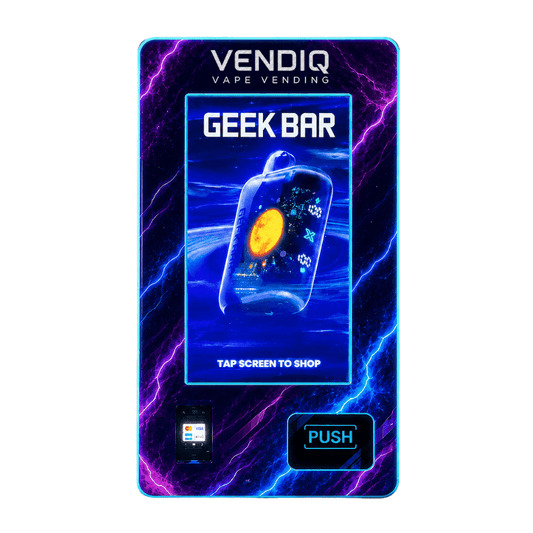
If you are wondering "Can Vending Machines Scan ID for Age Checks?" Yes. Modern vending machines can be equipped with ID scanners that verify a customer's age before allowing the purchase of age-restricted products.
Instead of relying on an employee to manually check identification, an age-verification vending machine can require the customer to scan a driver's license or government-issued ID before the machine unlocks the transaction.
For businesses selling products such as vapes, nicotine pouches, or other age-restricted items, this technology can make automated vending possible in locations where age verification is required.
The Quick Answer:
Yes. Vending machines can scan IDs for age verification using built-in or external ID scanners. The scanner reads the customer's date of birth from a driver's license or government-issued ID and allows the purchase only if the customer meets the required age.
How Does an ID Scanner on a Vending Machine Work?
The process is usually simple from the customer's perspective.
- The customer selects an age-restricted product.
- The vending machine asks the customer to scan their ID.
- The scanner reads information from the ID.
- The system calculates the customer's age.
- If the customer meets the required age, the machine allows the transaction to continue.
- If the customer does not meet the requirement, the purchase is blocked.
Many U.S. driver's licenses and identification cards contain a PDF417 barcode on the back. The American Association of Motor Vehicle Administrators, or AAMVA, includes PDF417 as the machine-readable barcode standard for driver's licenses and identification cards.
This allows compatible ID scanners to electronically read information such as the date of birth instead of requiring the customer to manually enter it.
Can a Vending Machine Tell If You Are 21?
Yes.
An ID scanner can read the date of birth encoded on a compatible ID and compare it with the current date. The vending machine can then determine whether the customer meets a programmed age requirement, such as 18+, 19+, or 21+.
For example, a vending machine selling nicotine products in the United States could be configured to require the customer to be at least 21 years old before continuing with the purchase.
The federal minimum age for purchasing tobacco products, including e-cigarettes, is 21.
What Types of IDs Can Vending Machines Scan?
Compatibility depends on the specific scanner and software being used, but age-verification systems may support identification such as:
- U.S. driver's licenses
- State-issued identification cards
- Certain Canadian identification cards
- Other supported government-issued IDs
Because identification formats vary between states and countries, businesses should confirm which IDs their specific scanner supports before installing a machine.
Does an ID Scanner Detect Fake IDs?
This depends on the technology.
A basic barcode reader may primarily read the information stored in the barcode and determine the age associated with it. More advanced age-verification systems can incorporate additional checks intended to identify invalid, altered, or suspicious identification.
That distinction is important.
Reading an ID and authenticating an ID are not necessarily the same thing.
Businesses purchasing an age-verification vending machine should ask what the scanner actually verifies, which identification formats it supports, and what happens when an ID cannot be validated.

Can Vape Vending Machines Scan IDs?
Yes. Vape vending machines can be built with integrated age-verification systems that require an ID scan before a customer can purchase a product.
This can be especially useful in places such as:
- Bars
- Nightclubs
- Casinos
- Private clubs
- Other age-restricted venues
However, adding an ID scanner does not automatically make a vending machine legal everywhere.
Federal rules prohibit tobacco vending machine sales in facilities where people under 21 are present or permitted to enter at any time.
States and local governments may impose additional licensing, placement, age-verification, or vending requirements.
Businesses should always check the laws that apply in the specific state and city where the machine will operate.
Why Add an ID Scanner to a Vending Machine?
Age-verification technology allows businesses to combine automated retail with an additional control before age-restricted products can be purchased.
Automated Age Checks
Customers can verify their age directly at the machine instead of requiring an employee to approve every transaction.
24/7 Availability
Where legally permitted and during the venue's operating hours, vending machines can sell products without requiring a dedicated cashier.
Consistent Verification
The machine follows the same programmed age-verification process for each transaction rather than relying solely on someone's visual estimate of a customer's age.
Better Customer Experience
A properly configured system can complete the age-check process in seconds and allow eligible customers to continue directly to payment.
Remote Vending Management
Modern vending machines can also combine age verification with features such as cashless payments, touchscreen interfaces, inventory monitoring, sales analytics, and remote machine management.
Do ID Scanners Store Your Information?
That depends on the scanner, software provider, and how the system is configured.
Some systems may only need information required to determine whether the customer meets the age threshold. Others may process additional information as part of authentication, transaction logging, fraud prevention, or regulatory requirements.
Operators should understand what information their system reads, whether information is stored, how long it is retained, and what privacy requirements apply to their business.
Is an ID Scanner Required for an Age-Restricted Vending Machine?
Not in every situation.
Requirements vary based on:
- The product being sold
- The state
- The city or municipality
- The type of venue
- Who is permitted inside the venue
- The age-verification technology being used
An ID scanner can be an important part of an age-restricted vending system, but it should be treated as one component of compliance rather than a replacement for understanding applicable laws.
For tobacco products specifically, FDA rules still restrict vending machine placement to facilities where individuals under 21 are not present or permitted to enter.
Age Verification Is Changing Vending
Traditional vending machines were designed to dispense everyday products with little interaction beyond selecting an item and paying.
Modern vending technology can do much more.
Touchscreens, cashless payments, remote inventory tracking, connected vending software, and ID scanners make it possible to build vending machines specifically for products that require additional controls.
For operators, the result is a vending experience that can verify age, accept payment, dispense a product, and record the transaction within one automated system.
Conclusion
Yes, some modern vending machines can verify a customer's age by scanning their ID before completing a purchase. These systems are commonly used for age-restricted products such as vapes and nicotine pouches, although local laws still determine where and how the machines can operate.
Looking for a Vending Machine With an ID Scanner?
BuzzBot offers modern vending machines designed for today's operators, including configurations for age-restricted products and optional age-verification technology.
Whether you are looking for a compact wall-mounted machine or a larger touchscreen vending machine, the right setup depends on the products you plan to sell, your venue, and local regulations.
Explore BuzzBot vending machines and find the setup that fits your business.
This article is for general informational purposes and is not legal advice. Laws and regulations governing vending machines and age-restricted products vary by jurisdiction.